

Autism Awareness: How the Insanos MC is Fighting for Inclusion

There is something quietly powerful about a motorcycle club — an organization built on brotherhood, loyalty, and the freedom of the open road — choosing to dedicate itself to the most vulnerable members of society. The Insanos MC, the largest motorcycle club in the world, does exactly that. And every year in April, the club turns its full force toward one of the most important causes on the global health agenda: autism awareness and inclusion.
With over 21,000 members, 1,050+ chapters across 61 countries, and a documented history of more than 20,000 social actions carried out in 2025 alone, the Insanos MC has built one of the most impactful voluntary community programs in Latin America. Their autism awareness campaigns are among the most personal and consistent expressions of that mission.
What Is Autism and Why Does Awareness Matter?
Before understanding what the Insanos MC does for the autism community, it helps to understand the scale of the challenge.
Autism Spectrum Disorder (ASD) is a neurodevelopmental condition characterized by differences in social communication, interaction, and behavior. The word "spectrum" reflects the extraordinary range of how ASD manifests — from individuals who live fully independent lives to those who require intensive daily support. No two autistic people are the same.
According to the World Health Organization, approximately 70 million people worldwide live on the autism spectrum — roughly 1 in every 100 children globally. In the United States, the Centers for Disease Control and Prevention estimates that about 1 in 36 children is diagnosed with ASD. In Brazil, estimates point to around 2 million people living with autism, though there is no official national census.
Despite these numbers, autistic people and their families continue to face significant barriers: delayed or inaccessible diagnosis, underfunded public services, social stigma, exclusion from schools and workplaces, and a broader public that often misunderstands what autism actually is.
Awareness campaigns exist to close that gap — and in Brazil, the most important of them takes place every April.
Brazil's "Abril Azul" — The Brazilian Autism Awareness Month
In Brazil, April is known as Abril Azul — literally "Blue April" — the national month dedicated to autism awareness and acceptance. The campaign is anchored on April 2nd, World Autism Awareness Day, established by the United Nations in 2007 to promote and protect the fundamental rights of people with disabilities, including those with autism.
The color blue was chosen because autism diagnoses are historically more common in males, occurring at a ratio of roughly four to one compared to females — a disparity science has yet to fully explain. In addition, studies suggest that the color blue has a calming effect, which can be beneficial for individuals who experience sensory overload, a common challenge associated with ASD.
Abril Azul's mission goes beyond symbolic gestures. The campaign pushes for concrete action: earlier diagnosis, better access to therapies, legal protection, school inclusion, workplace integration, and most fundamentally — a society that understands and embraces neurodiversity.
The 2025 national theme for Abril Azul in Brazil was "Information generates empathy; empathy generates respect" — a framing that resonates deeply with the values the Insanos MC brings to the table.
How the Insanos MC Engages With Autism Awareness
The Insanos MC's involvement in autism awareness is not a one-time gesture or a seasonal social media campaign. It is embedded in the club's broader social mission, which requires every one of its 1,050+ chapters to carry out at least one social action per year — with chapters encouraged to engage with causes that directly affect their local communities.
Autism is one of those causes. Across Brazil, Insanos MC chapters participate in Abril Azul each year through a range of actions that reflect the club's grassroots, community-first approach.
🔵 Awareness Campaigns and Educational Outreach
Insanos MC chapters participate in local Abril Azul events in their cities, distributing informational materials about ASD, wearing blue to signal solidarity, and using the club's significant social media reach to amplify awareness messages during the month of April.
For a club with over 21,000 members and millions of followers across its official and chapter-level social media profiles, this amplification is not trivial. When the Insanos MC pushes an awareness message, it reaches communities that traditional health campaigns often struggle to penetrate — working-class neighborhoods, smaller cities, and social networks where motorcycle culture is central to community identity.
🔵 Institutional Visits and Direct Engagement
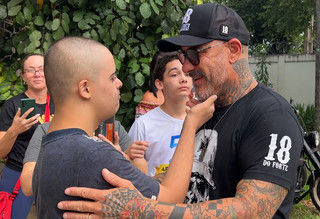
Several Insanos MC chapters have documented visits to ASD support institutions, therapeutic clinics, and schools serving autistic children and adults during Abril Azul. These visits combine the delivery of material donations — toys, sensory items, and hygiene products — with the human dimension of presence and connection.
For children with autism, structured, positive social interactions with new people can itself be therapeutic. The arrival of motorcycle riders — figures of curiosity and excitement for many children — in a supportive, calm, and respectful environment creates memorable moments that go beyond the material value of any donation.
🔵 Blue Illumination and Symbolic Actions
In alignment with the global "Light It Up Blue" initiative — observed every April 2nd when iconic landmarks worldwide are bathed in blue light — Insanos MC chapters organize local symbolic actions: blue illuminations, public gatherings, and community rides to mark World Autism Awareness Day.
These symbolic actions matter because they make autism visible in spaces where it might otherwise be invisible. A group of motorcyclists gathering in blue in the town square signals to every family navigating an autism diagnosis nearby: you are not alone, and your community sees you.
🔵 Support for Families and Caregivers
One of the most underacknowledged dimensions of autism advocacy is the toll it takes on families and caregivers — particularly mothers, who in Brazil often bear a disproportionate burden of the work of raising and advocating for autistic children. The Insanos MC's social programs, which include food support and community assistance for vulnerable families, intersect directly with the needs of families navigating the financial and logistical challenges of autism care.
In many cases, a family caring for a child with ASD is also a family dealing with reduced working hours, higher medical expenses, and limited access to specialized services. The Insanos MC's broader social safety net — its food campaigns, clothing drives, and community assistance programs — serves these families too.
Why Motorcycle Riders Are Becoming Autism Advocates
The idea of motorcycle clubs as champions of autism awareness might surprise some people. But there is a logic to it that goes beyond goodwill.
Motorcycle culture in Brazil is deeply rooted in working-class and middle-class communities — the same communities where autism diagnoses are most likely to be delayed or missed due to lack of access to specialists. In many Brazilian cities, a family's first encounter with information about autism awareness does not come from a pediatric clinic. It comes from a neighbor, a friend, or a community organization they already trust.
The Insanos MC is exactly that kind of trusted presence. Its chapters are embedded in neighborhoods across every Brazilian state. When the club's members speak about autism awareness — through social media posts, roadside actions, or face-to-face conversations — they are reaching people who might never walk into a health seminar or read a government brochure.
That grassroots credibility is irreplaceable. And it is why the club's autism advocacy, however understated, carries weight that far exceeds its institutional profile.
The Numbers Behind Autism in Brazil and the World
To fully appreciate the importance of what the Insanos MC is doing, consider the context:
Statistic | Number |
People with autism worldwide (WHO) | ~70 million |
Children with autism globally (1 in every...) | 100 children |
People with autism in Brazil (estimated) | ~2 million |
Children with autism in Brazilian schools (2023 census) | 636,202 students |
Percentage in mainstream classrooms | 95.4% |
Ratio of autism diagnosis: male to female | ~4:1 |
Age range when symptoms are typically identified | 12–24 months |
Average age of clinical diagnosis in Brazil | 4–5 years |
These numbers tell a story of scale — and of gap. Over 636,000 autistic students are enrolled in Brazilian mainstream classrooms, yet many schools lack the specialized support staff and adapted materials needed to serve them effectively. Early diagnosis, which is critical for effective intervention, is still inaccessible for many families in smaller cities and rural areas.
This is the landscape the Insanos MC steps into when it participates in Abril Azul. And it is a landscape where a well-organized, trusted community organization can genuinely move the needle.
The Brazilian Legal Framework: Rights the Insanos MC Is Helping Publicize
One of the important contributions of autism awareness campaigns in Brazil — including those run by the Insanos MC — is publicizing rights that many families do not yet know they have.
Brazil has some of the most comprehensive autism-related legislation in Latin America, anchored by the Lei Berenice Piana (Law 12.764/2012), which formally recognizes autism as a disability and establishes the National Policy for the Protection of the Rights of Persons with ASD. Under this law, people with autism have the right to early diagnosis, specialized educational support, access to multiprofessional care through the public health system, and pathways to professional training and labor market inclusion.
Additional protections include the Carteira de Identificação da Pessoa com TEA (CIPTEA) — a formal identification card for people with autism that facilitates access to priority services, medications, and public benefits — and the Lei Brasileira de Inclusão (Law 13.146/2015), which guarantees the right to inclusive education for all students with disabilities.
When the Insanos MC participates in Abril Azul events, distributes materials, and amplifies awareness messages, it is also — whether explicitly or not — spreading knowledge of these rights to families who may not know them. In a country where access to legal information is often correlated with socioeconomic status, that contribution has real value.
A Club With a Conscience: The Broader Context of the Insanos MC Social Mission
The autism campaigns do not exist in isolation. They are one thread in a much larger tapestry of social commitment that defines the Insanos MC.
In November 2024, the club set a national record in Brazil with 9,496 liters of blood donated in a single campaign — the largest ever recorded by any single organization in Brazilian history, with the potential to benefit up to 84,000 lives. In 2025 alone, the club carried out more than 20,000 social actions across its chapters worldwide. It runs food drives, winter clothing campaigns, animal welfare programs, mental health awareness initiatives, and support for people with disabilities.
Autism awareness sits within this ecosystem of solidarity. It is consistent with a club whose entire philosophy holds that no one — regardless of how invisible their challenges may be to others — gets left behind.
Social Director of the Insanos MC, Claudio Ribeiro, has described the club's core identity this way: the club is social at its core, and every chapter has the obligation to act. That obligation extends to children and families navigating autism diagnoses, to caregivers who need to know their rights, and to communities that deserve to be informed.
What Autism Acceptance — Not Just Awareness — Looks Like
It is worth noting a distinction that has become increasingly important in the global autism advocacy community: the difference between awareness and acceptance.
Awareness means acknowledging that autism exists and is prevalent. Acceptance means recognizing autistic people as full members of society who deserve inclusion, support, and respect — not despite their neurology, but as they are.
The most thoughtful autism advocates today — including many autistic people themselves — emphasize that the goal is not awareness for its own sake, but the creation of genuinely inclusive communities. That means accessible schools, adapted workplaces, sensory-friendly public spaces, and above all, a shift in social attitudes from pity to respect.
When the Insanos MC sends its members into communities across Brazil to engage with autism awareness in April, to donate to support institutions, and to use their platform to spread information, the club is participating in that larger project. It is not presenting autism as a tragedy to be mourned. It is presenting autistic people as members of the community who deserve the same solidarity the club extends to everyone else it serves.
That is, ultimately, what brotherhood looks like when it is taken seriously.
How to Support Autism Awareness Alongside the Insanos MC
If you want to support autism awareness in the spirit of the Insanos MC — whether you are in Brazil or anywhere else in the world — here are meaningful ways to act:
Learn and share. Understanding what autism actually is — a neurodevelopmental condition, not a disease, not a tragedy — is the foundation of genuine support. Share accurate information with your networks, especially during April.
Support local autism organizations. In your city or state, there are likely organizations providing therapy, family support, and advocacy for the autism community. Donating, volunteering, or simply spreading awareness of their work makes a direct difference.
Practice inclusion. In your workplace, school, neighborhood, and social spaces, advocate for sensory-friendly environments, patient communication, and the accommodation of neurodivergent people.


Comments